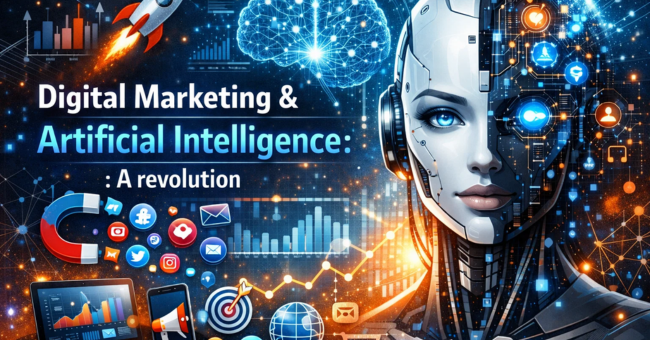
Artificial Intelligence (AI) is no longer a futuristic promise—it has become a core driver of digital marketing transformation. Powered by advanced algorithms, machine learning models, and large-scale data analytics, AI enables companies to understand, predict, and influence consumer behavior with unprecedented accuracy. As competition intensifies across industries, businesses that leverage AI-driven marketing strategies gain a measurable advantage in performance, personalization, and profitability.
Key Areas Where AI Is Transforming Digital Marketing
Targeted Advertising & Campaign Optimization
AI allows marketers to analyze user behavior across multiple touchpoints—web browsing, social media interactions, purchase history, and search patterns—to deliver highly relevant ads. Platforms such as Google Ads and Meta Ads rely heavily on machine learning to automatically optimize bidding strategies, segment audiences, and adjust campaigns in real time.
Instead of relying solely on manual A/B testing, AI continuously refines targeting parameters, reallocates budgets toward high-performing segments, and predicts which creatives are most likely to convert. This results in significantly improved return on investment (ROI), lower acquisition costs, and higher engagement rates.
Chatbots & Virtual Assistants
AI-powered chatbots provide 24/7 customer support across websites, messaging apps, and social media platforms. Using natural language processing (NLP), these virtual assistants can understand user intent, answer frequently asked questions, recommend products, and guide customers through purchasing processes.
Beyond customer service, chatbots play a strategic role in lead generation and qualification. They collect valuable data, personalize conversations, and nurture prospects automatically—freeing marketing teams to focus on strategy, creativity, and growth initiatives.
Personalization of the Customer Experience
Personalization has become the cornerstone of modern digital marketing. By analyzing browsing history, purchasing patterns, demographic information, and engagement data, AI systems deliver tailored product recommendations, personalized email content, and dynamic website experiences.
E-commerce platforms, streaming services, and online retailers use recommendation engines to increase average order value and customer retention. The more data AI processes, the more precise and relevant the customer journey becomes—strengthening loyalty and long-term brand relationships.
Content Creation & Predictive Insights
AI is also revolutionizing content marketing. Generative AI tools can assist in writing blog posts, social media captions, email campaigns, and even ad copy—while predictive analytics identifies which content topics are likely to resonate with specific audiences.
Through sentiment analysis and trend forecasting, marketers can anticipate consumer preferences and adapt their messaging before competitors do. This proactive approach transforms marketing from reactive execution to predictive strategy.
Major Benefits of AI in Marketing
- Automation of repetitive tasks: Email campaigns, social media scheduling, customer segmentation, and reporting can be streamlined, saving time and operational costs.
- Advanced data analysis: AI processes massive datasets in seconds, uncovering hidden patterns and actionable insights.
- Improved decision-making: Real-time dashboards and predictive models help marketers make faster, data-driven decisions.
- Higher campaign performance: Better targeting, optimized budget allocation, and dynamic personalization improve ROI.
- Enhanced customer experience: Personalized, relevant interactions increase satisfaction and brand loyalty.
Challenges & Limitations of AI in Marketing
Despite its advantages, AI presents significant challenges. Algorithmic bias remains a concern—if training data is incomplete or skewed, recommendations may become unfair or discriminatory. Transparency and ethical data usage are critical, especially in light of evolving privacy regulations such as GDPR and CCPA.
Additionally, over-automation can risk losing the human touch. Successful marketing still requires creativity, emotional intelligence, and brand storytelling—elements that AI supports but cannot fully replace.
Implementing AI solutions also demands technical expertise and continuous learning. Marketers must understand data analytics, machine learning fundamentals, and performance measurement to fully leverage AI’s potential.
Why Digital Marketing & AI Training Matters
As AI reshapes the industry, continuous education becomes essential. Specialized programs in digital marketing and AI equip professionals with skills in data analytics, project management, automation tools, and strategic communication.
These programs prepare graduates for in-demand roles such as digital project manager, traffic manager, content strategist, CRM manager, marketing automation specialist, and data analyst. Companies increasingly seek hybrid profiles capable of combining creativity with analytical thinking and technological expertise.
The Future of Digital Marketing 2.0
The evolution of AI—particularly in machine learning, natural language processing, predictive modeling, and generative content—points toward a future defined by precision and intelligent automation. Voice search optimization, hyper-personalized video content, real-time customer journey orchestration, and AI-driven predictive sales funnels will become standard practices.
Organizations that integrate AI into a cohesive, data-driven strategy will outperform competitors in agility and innovation. Rather than replacing marketers, AI acts as an amplifier—enhancing their ability to understand audiences, craft compelling experiences, and deliver measurable business impact.
In conclusion, AI is no longer an optional tool in digital marketing—it is a strategic necessity. For modern marketers, embracing AI represents an opportunity to innovate, differentiate, and build meaningful, scalable growth in an increasingly data-driven world.